

Loading
Just a moment while this page opens.
Just a moment while this page opens.
Just a moment while this page opens.
How Alberta chooses immigrants, the Alberta streams our report checks, what changes if you already live, study or work in Canada, and what life is like in its main cities.

Photo: DXR(opens in a new tab), CC BY-SA 4.0(opens in a new tab), cropped
To make Alberta your permanent home, one route is the province's own program, the Alberta Advantage Immigration Program (AAIP). Alberta does not issue permanent residence (PR, the right to live in Canada permanently) itself. The AAIP nominates people for it, and Immigration, Refugees and Citizenship Canada (IRCC), the federal immigration department, manages the PR application, with the Government of Canada making the final decision. Alberta says its nominees must have skills to fill job shortages or plan to buy or start a business in the province, and must be able to provide for their families. One detail stands out: the points Alberta gives worker profiles reward a job offer outside greater Calgary and Edmonton, to support rural economic development.
Yes. Alberta runs the Alberta Advantage Immigration Program (AAIP), a provincial nominee program: the province chooses (nominates) people it wants, and the federal government then decides on their permanent residence, the status that lets you live and work in Canada with no time limit.
Alberta Advantage Immigration Program (AAIP)A stream is one route within a program, with its own rules. Our report checks 8 Alberta streams against your answers.
AAIP Alberta Express Entry Stream
For people who have a profile in Express Entry, Canada's online system for skilled workers, with a points score there that meets Alberta's minimum and an occupation Alberta prioritizes.
AAIP Alberta Opportunity Stream
For people who already work in Alberta on a work permit, with enough full-time experience in their job and a full-time job offer from an Alberta employer.
For people with farm management experience and enough money of their own to start or buy a farm in Alberta, backed by a business plan.
AAIP Foreign Graduate Entrepreneur Stream
For people with a degree from outside Canada who want to launch a start-up in Alberta in a key industry, with a recommendation from an agency Alberta has approved.
AAIP Graduate Entrepreneur Stream
For graduates of a publicly funded Alberta college or university who hold Canada's work permit for graduates and want to start or buy a business in Alberta.
AAIP Rural Entrepreneur Stream
For experienced business owners or senior managers with enough personal wealth to start or buy a business in a rural Alberta community that supports their plan.
For workers who have a full-time job offer from an employer in a participating rural Alberta community and a letter from that community supporting them.
AAIP Tourism and Hospitality Stream
For tourism and hospitality workers in Alberta whose employer got government permission to hire them, with enough time working there and a full-time job offer from that employer.
You can apply to an AAIP worker stream only if Alberta invites you. First you submit a Worker Expression of Interest (EOI), an online profile in the AAIP portal where you declare your own details; it goes into a pool and is scored out of 100 points (How to apply). There is no minimum score to submit one, and it stays valid for 12 months.
Alberta then holds draws, rounds in which it selects people from the pool to invite by email. Its processing page says draws are not regularly scheduled but happen as needed for sector needs and provincial priorities, and that you may be invited to a different stream from the one you chose. The score is not the only factor: Alberta's answers to common questions say draws can target occupations or sectors in demand regardless of score, and that claimed points are checked twice, at invitation and again at assessment. Once invited, you have 15 days to accept and then 30 days to complete and submit the application.
Alberta says its emails always come from an @gov.ab.ca address, never from services such as Gmail, and that employers and employment agencies cannot charge you a fee for a job offer; our guide to spotting immigration scams explains more.
The Rural Entrepreneur, Graduate Entrepreneur and Foreign Graduate Entrepreneur streams also start with an EOI (AAIP), while the Farm Stream takes applications, with a business plan, directly.
A nomination is not PR: once nominated, you apply to IRCC, which decides. Our guide to provincial nominee programs explains the difference. Through the Alberta Express Entry Stream, a nomination can be linked to Express Entry, the federal system that ranks skilled workers, and IRCC says such a nomination adds 600 points; our Express Entry guide covers that system.
This stream lets Alberta nominate a limited number of people from Express Entry. Its eligibility page asks for an active Express Entry profile that meets a federal program, and a minimum score in the Comprehensive Ranking System (CRS), Express Entry's points score, which our CRS calculator estimates. The main occupation in your profile must fit a pathway of the stream or a provincial priority (stream page):
A job offer is not always needed, but if you are invited because of one, you and your employer must meet Alberta's job offer requirements, and the eligibility page warns that a profile expiring within five months makes an invitation less likely.
In the Rural Renewal Stream, a community chooses you before Alberta does. A rural community must apply to the province for designation and must lie outside the Calgary and Edmonton census metropolitan areas, the city regions Statistics Canada draws around those cities (community designation). Each designated community gets a yearly allocation of endorsements. Its economic development organization issues an Endorsement of Candidate letter, valid for one year, and you also need a full-time job offer from an established business in that community (eligibility). Some occupations are excluded for everyone, and people applying from abroad need a job at TEER 0 to 3. TEER is how Canada's occupation codes group jobs, from 0 to 5, by the training, education, experience and responsibilities they require. The limits on endorsements and the one-year validity of letters took effect on 1 January 2026 (AAIP updates).
The Rural Entrepreneur Stream also runs through communities: you make an exploratory visit, in person or by video call, and a participating community must give you a Community Support Letter before you submit an EOI (eligibility).
Both are separate from the federal Rural Community Immigration Pilot, which IRCC runs with communities it selects in several provinces.
A relative in Alberta can add points to a Worker EOI, but only a close one. Alberta's answers page says the relative must live in Alberta, be a Canadian citizen or permanent resident, and be over 18. For EOIs submitted after 29 January 2025, only a parent, sibling or child counts. The relationship must be by birth or adoption, with legal documents to prove it, and in-laws never count.
The Rural Entrepreneur Stream uses its own list. Its eligibility page counts an Alberta relative among the factors that may improve your chances, and defines relatives as a father, stepfather, mother, stepmother, child, stepchild, sister, stepsister, brother or stepbrother of you or your spouse or common-law partner.
For 2026, Alberta's processing page says it will prioritize draws and nominations in its worker streams for occupations in health care, technology, construction, manufacturing, aviation and agriculture, and for communities designated under the Rural Renewal Stream, while noting that the list is not exhaustive.
The Worker EOI awards points for things such as education, work experience, family in Alberta and an Alberta job offer, and a job offer in a regulated trade earns 10 points if you hold a valid Alberta Qualification Certificate or a trade certificate recognized by Alberta Apprenticeship and Industry Training (answers page). Alberta also collects details it does not score, such as your work permit status, your job offer's occupation code, your employer's line of business, and your wage and hours, to aim draws at sector needs (How to apply).
In 2026, extra federal spaces let Alberta nominate practice-ready physicians and French speakers without using its own allocation; its processing page says a French speaker can work in any AAIP-eligible occupation but needs at least level 5 in French in listening, speaking, reading and writing, on the NCLC, Canada's scale for French.
Register for the Alberta Health Care Insurance Plan (AHCIP) at a registry agent, an office handling registrations and licences for the government, with the application form and original documents proving your Alberta residence, identity and legal right to be in Canada. Registry agents also exchange driver's licences: Alberta's list of places whose licences can be swapped without tests includes the United Kingdom and Japan, while licences from places without an exchange agreement need a knowledge test and a road test. Make Alberta your home describes the settlement services the province funds, free to work permit holders, refugee claimants and naturalized citizens, and IRCC's Find free newcomer services near you tool covers permanent residents and other eligible newcomers.
Alberta weighs its own work more heavily. On a Worker EOI, six months or more of work in Alberta earns 10 points, against 6 for the same work in another province or territory (points grid).
The Alberta Opportunity Stream is built around a job you already hold (eligibility). When you apply, and again when Alberta assesses the application, you must work full-time in Alberta for an Alberta employer, in an eligible occupation, on a valid work permit of a type the stream lists; waiting on an extension under maintained status does not count. You also need 12 months of full-time work in that occupation in Alberta within the last 18 months, or 24 months in Canada or abroad within the last 30.
Living in Alberta on a valid work permit also lets you use a Rural Renewal Stream job at any TEER level, 0 to 5, outside the excluded occupations (eligibility).
Most of Alberta's graduate rules below build on the post-graduation work permit (PGWP), which IRCC offers graduates of certain designated schools so they can work in Canada after they finish studying.
None of the last three rules applies to graduates of another province's schools, though their Canadian education still earns the 6 points.
On a permit, living or working in another province or territory rules you out of the Alberta Opportunity Stream (eligibility), and living elsewhere in Canada on a work permit limits a Rural Renewal Stream job to TEER 0 to 3 (eligibility).
If you plan to stay 12 months or more, Alberta's page for moves from another province says to register for AHCIP within 3 months. Alberta coverage begins on the first day of the third month after you take up residence, and meanwhile you can keep using your previous province's card for what it still covers. A permit needs 6 months or more left. By status:
Driving: once you live in Alberta permanently, you have 90 days to exchange your licence at a registry agent, with no knowledge or road test for a car licence; students can keep driving on theirs (licence exchange).
Settling in: the first-steps section above names the settlement services Alberta funds, open to work permit holders.
These federal programs run only in some provinces or communities, and Alberta is one of them.
For workers with a job offer from an employer approved by a participating rural or remote community, and a recommendation from that community, where they plan to settle.
Communities taking part in Alberta

Photo: DXR(opens in a new tab), CC BY-SA 4.0(opens in a new tab), cropped
Population: 1,306,784 (Statistics Canada, 2021 Census)
Calgary's place on the map decides which routes in the AAIP, Alberta's own immigration program, a job here can support. The Rural Renewal Stream only designates communities outside the Calgary and Edmonton census metropolitan areas, the city regions Statistics Canada draws around each city, so a job in Calgary cannot be used for it (community designation), and the Rural Entrepreneur Stream only counts communities outside those areas (eligibility). Nor does a job here earn the extra points that a Worker EOI (the scored online profile workers submit to be invited) gives for a job offer outside greater Calgary and Edmonton (answers page).
The City of Calgary's newcomer page points to a guide for your first days, weeks and months in the city and to local settlement organizations, and says its 3-1-1 phone agents can use a translation service covering more than 200 languages.
The University of Calgary, a public university founded in 1966, sits northwest of where the Bow River meets the Elbow River, a site it says is traditionally known as Moh’kins’tsis to the Blackfoot, Wîchîspa to the Stoney Nakoda and Guts’ists’i to the Tsuut’ina. Mount Royal University, founded in 1910, became a university with a greater focus on bachelor's degrees in 2009 and is based at its Lincoln Park campus. SAIT, the Southern Alberta Institute of Technology, was established in 1916. The province lists SAIT as a polytechnic serving southern Alberta and Bow Valley College as a community college serving Calgary and region (types of institutions).

Photo: Mack Male(opens in a new tab), CC BY-SA 2.0(opens in a new tab)
Population: 1,010,899 (Statistics Canada, 2021 Census)
Edmonton is Alberta's capital, roughly in the centre of the province on the North Saskatchewan River. The City says Edmonton began in 1795 as a trading post called Fort Edmonton, known as amiskwaciwâskahikan, and became Alberta's capital in 1905.
Under the AAIP, Alberta's own immigration program, a job in Edmonton does not earn the extra points that a Worker EOI (the scored online profile workers submit to be invited) gives for a job offer outside greater Calgary and Edmonton (answers page), and it cannot support a Rural Renewal Stream application, since designated communities must lie outside the Edmonton census metropolitan area (community designation).
New arrivals can use the City's Citizen and New Arrival Information Centre on the main floor of City Hall, and its 311 line offers interpreters in more than 180 languages. The University of Alberta has its North Campus on the edge of the North Saskatchewan River and a French-language campus, Campus Saint-Jean, in the heart of Edmonton's francophone community. MacEwan University sits at the heart of the city, and the Northern Alberta Institute of Technology (NAIT) is also in Edmonton. The province lists NAIT as a polytechnic serving northern Alberta and NorQuest College as a community college serving Edmonton and region (types of institutions).
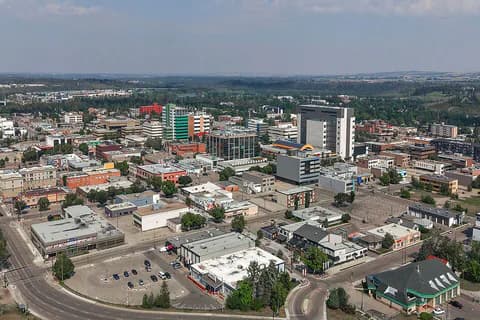
Photo: Quintin Soloviev(opens in a new tab), CC BY 4.0(opens in a new tab)
Population: 100,844 (Statistics Canada, 2021 Census)
Red Deer is in Central Alberta, midway between Edmonton and Calgary, and the Queen Elizabeth II Highway connects it to both (Moving to Red Deer). The City says its key industries, measured by labour force, include health care and social assistance, retail trade, construction, mining, quarrying and oil and gas extraction, accommodation and food services, manufacturing and educational services. It was incorporated as a city in 1913.
That position matters under the AAIP, Alberta's own immigration program. Its Worker EOI, the scored online profile workers submit to be invited, gives extra points for a job offer outside greater Calgary and Edmonton (answers page), and in the 2021 Census, Statistics Canada counts Red Deer as a census metropolitan area, a city region of its own, separate from Calgary's and Edmonton's.
Red Deer Polytechnic, which the province lists as a polytechnic serving Central Alberta (types of institutions), has a main campus with its four schools, research facilities and a residence, plus a downtown campus for continuing education. It names manufacturing, health care and health technology, energy innovation and social innovation as its areas of focus. The City's moving page points newcomers to Catholic Social Services' immigrant services and to Care for Newcomers.
Answer our free questionnaire and get a free summary of your eligibility for every Canada pathway we assess, including those in Alberta. The full report is a later choice, never a condition.
Start the free questionnaire