

Loading
Just a moment while this page opens.
Just a moment while this page opens.
Just a moment while this page opens.
How British Columbia chooses immigrants, the British Columbia streams our report checks, what changes if you already live, study or work in Canada, and what life is like in its main cities.

Photo: DXR(opens in a new tab), CC BY-SA 4.0(opens in a new tab)
If you want to live in British Columbia for good, the province's own route is its immigration program, the BC Provincial Nominee Program (BC PNP). B.C. cannot grant permanent residence (PR, the right to live in Canada permanently) itself. It selects people and nominates them, which means recommending them to Immigration, Refugees and Citizenship Canada (IRCC), the federal immigration department, and only IRCC's approval makes a nominee a permanent resident.
The program is for workers, entrepreneurs and businesses that meet B.C.'s labour market and economic development needs, and its worker streams generally need a full-time, open-ended job offer. B.C. says the program focuses its priorities on three core objectives: care, build and innovate.
Yes. British Columbia runs the BC Provincial Nominee Program (BC PNP), a provincial nominee program: the province chooses (nominates) people it wants, and the federal government then decides on their permanent residence, the status that lets you live and work in Canada with no time limit.
BC Provincial Nominee Program (BC PNP)A stream is one route within a program, with its own rules. Our report checks 7 British Columbia streams against your answers.
BC PNP Entrepreneur: Base Stream
For people with experience running a business and enough personal wealth to start one, or take over and grow one, in British Columbia.
BC PNP Entrepreneur: Regional Stream
For people with experience running a business who want to start one in a participating British Columbia community outside Metro Vancouver, with a referral from that community.
BC PNP Entrepreneur: Strategic Projects
For key employees of an established foreign company that is investing to set up operations in British Columbia, who have the experience to manage the business there.
BC PNP Skills Immigration: Health Authority
For health care workers offered a full-time job with no end date by one of British Columbia's public health authorities, which run the province's health services.
BC PNP Skills Immigration: Skilled Worker
For workers offered a full-time job with no end date by an eligible British Columbia employer, in a skilled occupation such as management, professional, technical or trade work.
Express Entry BC: Health Authority
For health care workers who have a profile in Express Entry, Canada's online system for skilled workers, and a job offer from one of British Columbia's public health authorities.
Express Entry BC: Skilled Worker
For people who have a profile in Express Entry, Canada's online system for skilled workers, and a full-time skilled job offer from an eligible British Columbia employer.
Most Skills Immigration streams start with a registration, which records your interest: you create a profile in the BC PNP Online User Portal and choose a stream, and for the Skilled Worker stream you need your employer's support first (For workers).
Each registration gets a score, which the Skills Immigration Program Guide sets out of 200 points. Up to 120 points come from human capital: work experience directly related to the job offer, education and language. Up to 80 come from the hourly wage of the job offer and where in B.C. the job is. A registration stays in the pool for up to 12 months.
From time to time the BC PNP invites the candidates it considers most likely to meet B.C.'s economic and labour market needs. The guide says it can select on attributes such as occupation, wage or a professional designation in B.C., and it can aim a round at one group of candidates. Under care, build and innovate, invitations can target listed health, childcare and veterinary jobs and French-speaking public school teachers, certified construction trade workers, and top talent in any sector. If invited, you have 30 calendar days to submit a complete application. The Health Authority stream skips registration: people who meet its requirements apply directly.
An approved application makes you a nominee, not yet a permanent resident. You apply to IRCC before your Confirmation of Nomination (the province's nomination letter) expires, and you must keep meeting the conditions of your nomination until you become a permanent resident, including telling the BC PNP about changes to your job or business, immigration status or family (For nominees). Our guide to provincial nominee programs explains the difference.
People in Express Entry, the federal online system that ranks skilled workers, may qualify for the Express Entry BC option of the Skilled Worker or Health Authority stream, and IRCC says a nomination linked to Express Entry adds 600 points; our Express Entry guide explains that system.
The registration score rewards jobs outside Metro Vancouver, the regional district of Vancouver and its neighbouring municipalities, and the program guide says this recognizes how hard it is for regional communities to attract and keep workers. The score gives no points for a job in the Metro Vancouver Regional District, 5 points for a job in Squamish, Abbotsford, Agassiz, Mission or Chilliwack, and 15 points anywhere else in B.C.
For entrepreneurs, the Regional stream only covers new businesses in participating communities outside Metro Vancouver.
Employers supporting a BC PNP application do not need a Labour Market Impact Assessment (LMIA), a federal check an employer may need before hiring a foreign worker, but they sign an Employer Declaration Form, provide documents and may get a workplace visit from the program (For employers).
Under the program guide, the employer must have operated in B.C. for at least a year and have at least five full-time employees with no fixed end date working in B.C. if it is in Metro Vancouver, or three elsewhere. You cannot hold or control 10 per cent or more of the business, work as an independent contractor or subcontractor, or take a job that keeps you outside B.C. most of the time. Your family income must reach a minimum that depends on where in B.C. you live and on your family's size, which counts your spouse or partner and dependent children even if they stay behind.
For language, the guide asks for at least level 4 in English or French in listening, speaking, reading and writing, measured on Canada's language scales (CLB for English, NCLC for French), unless the job offered is in TEER 0 or 1 (management or professional work in Canada's occupation codes), where the program may still ask for results while assessing your application. Our language score converter shows which CLB level a test result matches.
B.C.'s business streams reverse the usual order: you come on a work permit first and are nominated only after showing that you met the terms of an agreement with the province (For entrepreneurs and businesses).
In the Base and Regional streams you register a business proposal, and BC PNP staff score its business concept separately. If you are invited, a BC PNP-authorized accounting firm reviews your personal net worth and how you built it before you apply, and you may be interviewed.
If approved, you sign a Performance Agreement with the province and receive a letter supporting your work permit application to IRCC. You must arrive in B.C. within 12 months of receiving the work permit, run the business, and send a final report 18 to 20 months after arriving. The Regional stream also asks for an exploratory visit to the community and a referral from it.
The Strategic Projects stream follows similar steps but is for established foreign companies expanding into B.C., which propose key staff members for nomination.
On 23 April 2026, the BC PNP announced priorities built on care, build and innovate, expecting at least 35% of all nominations to go to people working outside Metro Vancouver. The 23 April 2026 announcement also said the Entry Level and Semi Skilled stream was officially closed, that no new student streams would be launched, and that its lists of ineligible occupations and employers would grow (BC PNP news).
New editions of the Skills Immigration Program Guide took effect on 28 May 2026 and 10 June 2026 (BC PNP archives). The May edition introduced a list of occupations that no Skills Immigration stream accepts, for applications submitted after 13 June 2026 (program guide): administrative professionals such as executive assistants and bookkeepers, retail sales and food service supervisors, real estate agents and salespersons, and religious leaders and workers (For workers).
On 18 August 2026, the BC PNP said the federal government had given it 1,000 more nominations, raising its allocation for 2026 to 6,254 (BC PNP news).
Enrol in the Medical Services Plan (MSP), B.C.'s public health insurance: the province says enrolment is mandatory for all eligible residents and their dependants, and Health Insurance BC answers questions about it. For driving, ICBC explains that some foreign licences can be exchanged for a B.C. licence without testing, while others also need a knowledge test and a road test. WelcomeBC's After arriving in B.C. page covers other early steps, such as a Social Insurance Number and a transit card. The province funds newcomer services for groups including temporary workers, international students and new citizens, and IRCC's Find free newcomer services near you tool covers permanent residents and other eligible newcomers.
B.C. rewards work you already do there when it scores a registration (program guide). Working full-time in B.C., in the occupation and for the employer named in your registration, adds 10 points, and a year of directly related, authorized work anywhere in Canada adds another 10. If your job offer is outside Metro Vancouver, a year of paid full-time work in B.C. outside Metro Vancouver in the five years before you register adds 10 points for regional experience.
If the job you are offered is the one you already hold, the guide says you must keep working in it full-time throughout the process.
The post-graduation work permit (PGWP) is a work permit that graduates of certain designated schools can get to work in Canada after their studies, and IRCC says work experience gained after you graduate may help you qualify for permanent residence.
In its 23 April 2026 announcement, B.C. said it would launch no new student streams and suggested that international graduates explore its existing streams, so graduates take the same worker routes as everyone else. The worker streams generally need a full-time job offer with no end date from a B.C. employer or health authority, in an occupation that the section on what changed in 2026 does not exclude (For workers). When you register (program guide):
The BC PNP's registration score has no penalty for living elsewhere in Canada, and the rows above say which points work or study in another province still earns. Skills Immigration asks for a B.C. job offer and the intention to live, work and settle in B.C. (program guide).
MSP, B.C.'s public health plan, covers people by status. Cover starts after a wait of the rest of the month you become a resident plus two months; B.C. tells people moving within Canada to keep their former plan meanwhile, so on a permit, check that it still covers you. By status:
Driving: ICBC says you have 90 days after moving to switch to a B.C. licence and can drive on yours meanwhile, and its page mentions B.C. testing only for a Class 1 commercial licence. Full-time students at a designated school can drive on their out-of-province licence.
Settling in: the first-steps section above names B.C.'s newcomer services, which include services for permit holders.
These federal programs run only in some provinces or communities, and British Columbia is one of them.
For workers with a job offer from an employer approved by a participating rural or remote community, and a recommendation from that community, where they plan to settle.
Communities taking part in British Columbia
For French speakers with a job offer from an employer approved by a participating French-speaking community outside Quebec, and a recommendation from that community, where they plan to settle.
Communities taking part in British Columbia
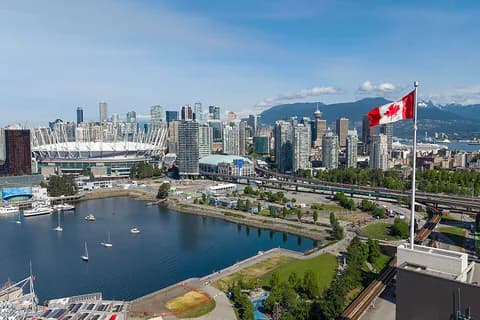
Photo: Quintin Soloviev(opens in a new tab), CC BY 4.0(opens in a new tab)
Population: 662,248 (Statistics Canada, 2021 Census)
The City of Vancouver is one of the member jurisdictions of Metro Vancouver, a partnership of municipalities, an electoral area and a treaty First Nation that plans and delivers regional services together.
That boundary matters for immigration. The BC PNP, B.C.'s own immigration program, scores the workers who register with it, and a job in the Metro Vancouver Regional District earns no points for its location, unlike a job elsewhere in B.C. (program guide), and the Entrepreneur Immigration Regional stream only covers communities outside it (Regional Immigration Collaboration). The Health Authority stream is for health professionals in B.C.'s public health care system, usually with a job offer from one of its health authorities (program guide), and the province's health authority lookup places Vancouver in Vancouver Coastal Health.
The University of British Columbia describes its Vancouver campus as sitting at the western tip of the Point Grey Peninsula, on the traditional territory of the Musqueam people, with another site downtown at Robson Square. Simon Fraser University's Vancouver campus is a cluster of buildings in the downtown core, among them Harbour Centre on West Hastings Street and the Segal Graduate School of Business.
To get around, WelcomeBC says TransLink runs the Vancouver area's buses, the SkyTrain, the SeaBus passenger ferry and the West Coast Express commuter rail, and that you pay for them with a Compass Card.
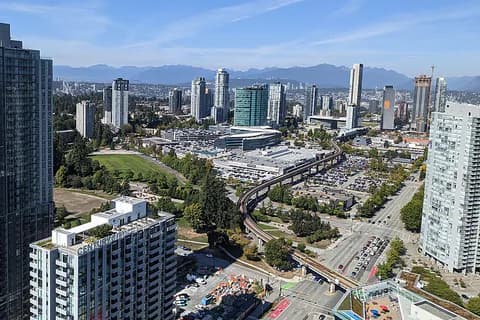
Photo: Northwest(opens in a new tab), CC BY 4.0(opens in a new tab), cropped
Population: 568,322 (Statistics Canada, 2021 Census)
Surrey is a city of several communities, which the City lists as Cloverdale, Fleetwood, Guildford, Newton, South Surrey and Whalley/City Centre (About Surrey). It is also a member of Metro Vancouver, so a job here earns no location points when B.C.'s own immigration program (the BC PNP) scores a registration (program guide), and its regional health authority is Fraser Health (health authority lookup).
The City partners with community organizations to offer settlement services in its recreation centres: resources and information for newcomers on finding a place to live, jobs, schools, childcare, health care and getting around, provided by DIVERSEcity, Options Community Services, Progressive Intercultural Community Services (PICS) and S.U.C.C.E.S.S. BC. At City facilities you can point to your language on a card at the counter and an interpreter will be called, and the City offers interpretation in more than 170 languages.
Kwantlen Polytechnic University was established by the government of British Columbia in 1981 and has campuses in Surrey, Richmond, Langley, Cloverdale and Civic Plaza. The Kwantlen First Nation gave the university its name, which means "tireless runner". SFU's Surrey campus is close to the Surrey Central transit station.
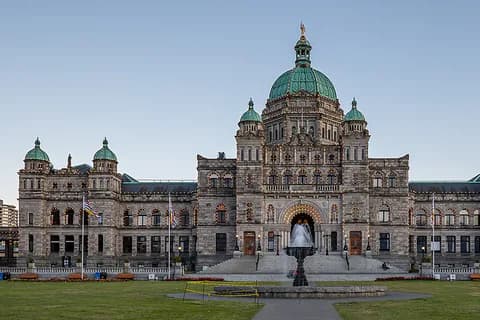
Photo: Michal Klajban(opens in a new tab), CC BY-SA 4.0(opens in a new tab), cropped
Population: 91,867 (Statistics Canada, 2021 Census)
Victoria, British Columbia, not the Australian state, is the province's capital, on the southern tip of Vancouver Island and on the homelands of the Songhees Nation and the Xwsepsum Nation (About Victoria). The City names tourism, government, high tech and education among Greater Victoria's employment industries, and says Island Health, formerly the Vancouver Island Health Authority, serves Greater Victoria's health care needs.
Victoria lies outside Metro Vancouver and outside the five communities that earn 5 points, so a job here falls in the guide's highest location band, worth 15 points, when B.C.'s own immigration program (the BC PNP) scores a registration, and a recent graduate of a public B.C. college or university outside Metro Vancouver may add points for that regional study (program guide).
The University of Victoria received degree-granting status in 1963 and traces its origins to Victoria College, founded in 1903. Camosun College teaches at its Lansdowne and Interurban campuses and at satellite locations around Greater Victoria, and the City's page also lists Royal Roads University. WelcomeBC says BC Transit provides bus service outside the Vancouver area, paid for with an Umo card.

Photo: GoToVan(opens in a new tab), CC BY 2.0(opens in a new tab)
Population: 144,576 (Statistics Canada, 2021 Census)
Kelowna is one of the communities taking part in the Francophone Community Immigration Pilot.
Kelowna is in B.C.'s Okanagan region. IRCC describes the federal Francophone Community Immigration Pilot as offering permanent residence to skilled workers who want to work and settle in rural, remote Francophone-minority communities, places where French speakers are a minority. The pilot asks for a valid job offer from an employer a participating community has designated; the employer sends your application to that community for a recommendation, and you can apply for PR only if it recommends you (Get a job offer). You also need at least level 5 in French in listening, speaking, reading and writing on the NCLC, Canada's scale for French (language requirement).
The City of Kelowna's newcomer page lists School District 93, the French-language public school board for British Columbia, and Kelowna Community Resources, which offers immigration services with interpretation in over 50 languages. The province's health authority lookup places Kelowna in Interior Health, and as a community outside Metro Vancouver, a job here earns location points when B.C.'s own immigration program (the BC PNP) scores a registration (program guide).
UBC Okanagan, in Kelowna, is situated on the traditional, ancestral, unceded territory of the Syilx Okanagan Nation. Okanagan College's Kelowna campus is steps from Pandosy Village and includes the Kelowna Trades Training Complex.
Answer our free questionnaire and get a free summary of your eligibility for every Canada pathway we assess, including those in British Columbia. The full report is a later choice, never a condition.
Start the free questionnaire