

Loading
Just a moment while this page opens.
Just a moment while this page opens.
Just a moment while this page opens.
How Yukon chooses immigrants, the Yukon streams our report checks, what changes if you already live, study or work in Canada, and what life is like in its main cities.

Photo: Jakub Fryš(opens in a new tab), CC BY-SA 4.0(opens in a new tab)
For workers, the Yukon's own immigration program is the Yukon Nominee Program (YNP), and it starts with a job: you need a full-time, year-round job offer from an eligible Yukon employer, and the employer applies for you.
If the application succeeds, the territory nominates you, meaning it recommends you to the federal government. You then apply for permanent residence (PR, the right to live in Canada permanently) to Immigration, Refugees and Citizenship Canada (IRCC), the federal immigration department. The territory says the Government of Canada grants work permits and PR, and that it cannot change those decisions.
The program is for jobs an employer could not fill with a qualified Canadian or permanent resident, and finding that job is up to you: the program does not recruit workers or keep a list of eligible employers.
Yes. Yukon runs the Yukon Nominee Program (YNP), a provincial nominee program: the province chooses (nominates) people it wants, and the federal government then decides on their permanent residence, the status that lets you live and work in Canada with no time limit.
Yukon Nominee Program (YNP)A stream is one route within a program, with its own rules. Our report checks 4 Yukon streams against your answers.
For workers whose Yukon employer applies for them, with a full-time, permanent, year-round job offer in an entry-level job, and related work experience.
For people who have a profile in Express Entry, Canada's online system for skilled workers, and a full-time, permanent, year-round skilled job offer from a Yukon employer.
For workers whose Yukon employer applies for them, with a full-time, permanent, year-round job offer in management or a job needing higher education, and related experience.
Yukon Business Nominee Program
For experienced business owners or managers with enough personal wealth who will start or buy a Yukon business, invest in it, and live in the territory to run it.
The territory calls the YNP employer-driven: the employer, not the worker, is the applicant.
For 2026, the process page says employers first submit an expression of interest, an online form rather than an application, and those scoring highest on the 2026 priorities are invited to apply. Those priorities for 2026 include regulated health care professionals, employers in rural Yukon, and foreign workers who have lived and worked in the Yukon for at least a year, are Yukon University graduates or speak French.
If approved, the employer, the worker and the Government of Yukon sign a Tripartite Agreement, and checks that it is followed can happen at any time. The nominee must then apply to IRCC for PR within six months of approval. A nomination is the territory's recommendation, not PR itself; our guide to provincial nominee programs explains the difference.
The YNP's Express Entry stream is for workers already in the Express Entry pool, the federal online system that ranks skilled workers by points, and IRCC says a nomination made through it brings 600 extra points. Our CRS calculator estimates your Express Entry score, and our Express Entry guide explains the system.
The territory's page for employers lists their duties. An employer must advertise the job for at least four weeks before applying and show that no qualified Canadian or permanent resident is available.
When the nominee is abroad, the employer agrees to pay for the worker's flight to the Yukon (not the family's) and, if the worker does not get PR, the flight home. In that case it also agrees to make sure suitable housing is available, to provide free health insurance until the worker qualifies for the territory's plan, and not to take back from the worker, through pay deductions or any other way, the cost of recruiting them, including money paid to a recruiter.
Employers also cannot, directly or indirectly, charge or collect a fee for nominating a foreign worker. An employer who asks you to pay for a nomination is breaking that rule; our guide to spotting immigration scams lists other warning signs.
Entrepreneurs use a separate program, the Yukon Business Nominee Program. Its eligibility page says you must score at least 65 points on its assessment grid, and must not yet have bought or started your Yukon business when you apply. The business must be new or an existing Yukon business you buy, managed by you, and not a passive investment. It must also be in a sector the territory names, such as information technology, manufacturing, forestry, tourism, energy, mining, agriculture, or film and video production; retail, restaurants and real estate are among the sectors it excludes.
Register in person for the Yukon Health Care Insurance Plan; you can apply on an open or Yukon-specific work permit valid for at least a year, but not on a study or tourist visa. The territory's page on transferring a driver's licence lists the places whose licences it recognizes, among them Canada and the United States. Moving to the Yukon gathers pages on jobs, credentials and finding a doctor, and IRCC's Find free newcomer services near you tool lists settlement help for eligible newcomers.
Living or working in the Yukon does not replace the job offer: as the opening of this page explains, a Yukon employer still applies for you. The territory ranks employers' expressions of interest against priorities it sets for the year, and a year lived and worked in the Yukon has been among them, as the section on how the YNP picks people shows. If you are already in Canada, the program's process page says you need valid status to work, and that refugee claimants and people in Canada on visitor status are not eligible.
A post-graduation work permit (PGWP) can let you work in Canada after your studies: IRCC says it allows graduates of eligible schools to gain Canadian work experience. Yukon University says it is a designated learning institution approved to host international students, and that its international graduates may be eligible for a PGWP.
Graduating from Yukon University has been among the priorities the territory sets for the year, which the section on how the YNP picks people lists. A degree or diploma from a school in another province or territory does not fit that priority, and a Yukon employer must still apply for you. Skilled work after you graduate can also count toward the federal Canadian Experience Class, the Express Entry program IRCC describes as being for skilled workers who have Canadian work experience; work done while you studied full time does not count.
Where the territory's priorities reward a year lived and worked in the Yukon, time elsewhere in Canada does not count. The flight, housing and health insurance listed in the section on what a Yukon employer must do apply when the nominee is abroad, so a mover should not count on them.
Apply for the Yukon Health Care Insurance Plan as soon as you arrive: the territory says new residents wait three months for cover, during which a mover from another province or territory stays on their former plan. By status:
The territory's licence transfer page says to switch to a Yukon licence within 120 days of moving, or 30 days with an air-brake endorsement. It names no test for a licence from elsewhere in Canada; you surrender the old one.
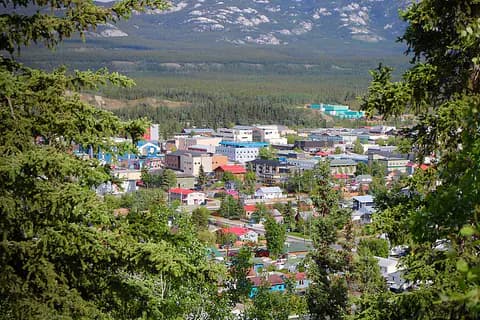
Population: 28,201 (Statistics Canada, 2021 Census)
The City of Whitehorse calls the Yukon's capital the Wilderness City. It sits on the banks of the Yukon River, within the traditional territories of the Kwanlin Dün First Nation and the Ta'an Kwäch'än Council, whose language, the City notes, is Southern Tutchone.
Yukon University has its main campus here. The campus is called Ayamdigut, a Tlingit name meaning "she got up and went", which Angela Sidney gave it when it opened in 1988. The institution began in 1963 as a vocational training centre and became Yukon University in 2020. The Yukon Nominee Program, the territory's immigration program for workers, lists Yukon University graduates among its priorities for 2026, according to its process page.
Newcomers join the territory's health plan in person, and in Whitehorse the health care card page gives the office as the 4th floor of 204 Lambert Street. For buses, the City's transit page has maps, routes and schedules.
Answer our free questionnaire and get a free summary of your eligibility for every Canada pathway we assess, including those in Yukon. The full report is a later choice, never a condition.
Start the free questionnaire