

Loading
Just a moment while this page opens.
Just a moment while this page opens.
Just a moment while this page opens.
How Prince Edward Island chooses immigrants, the Prince Edward Island streams our report checks, what changes if you already live, study or work in Canada, and what life is like in its main cities.

Photo: Gordon Leggett(opens in a new tab), CC BY 4.0(opens in a new tab)
To settle on Prince Edward Island for good, you can seek a nomination to the federal government through the province's own program, the PEI Provincial Nominee Program (PNP). The province says it selects people for nomination based on their intention to live and work in PEI and their economic ability to establish there. A nomination is a provincial recommendation, not permanent residence (PR, the right to live in Canada for good). Immigration, Refugees and Citizenship Canada (IRCC), the federal immigration department, decides the PR application itself, and it notes that a nomination on its own does not let you work in Canada.
The province calls its Skilled Worker, Critical Worker and International Graduate streams employer-driven: Island employers use them to fill positions they cannot fill through the local job market.
Yes. Prince Edward Island runs the PEI Provincial Nominee Program (PNP), a provincial nominee program: the province chooses (nominates) people it wants, and the federal government then decides on their permanent residence, the status that lets you live and work in Canada with no time limit.
PEI Provincial Nominee Program (PNP)A stream is one route within a program, with its own rules. Our report checks 5 Prince Edward Island streams against your answers.
PEI PNP Business Impact: Work Permit Stream
For experienced business owners or managers with enough personal wealth to invest in and run a Prince Edward Island business on a work permit before applying to stay permanently.
For people who have a profile in Express Entry, Canada's online system for skilled workers, with priority for those already living and working in Prince Edward Island.
PEI PNP Workforce: Critical Worker
For workers on a work permit, already working full time for a Prince Edward Island employer that offers them a full-time, year-round intermediate or entry-level job.
PEI PNP Workforce: International Graduate
For graduates of a publicly funded Prince Edward Island college or university who hold a work permit for recent graduates and a full-time, year-round job offer on the Island.
PEI PNP Workforce: Skilled Worker
For workers with a full-time, year-round job offer from a Prince Edward Island employer in a skilled job, and recent full-time work experience.
Every route into the PEI PNP starts with a profile in the province's online Expression of Interest system, says its Immigration Supports page. The Skilled Workers page adds that you can have only one active profile at a time, and that a profile stays active for six months.
The EOI draws page stresses that an expression of interest (EOI) is not an application but a sign of interest, and that the Office of Immigration may limit intake or make exclusions from draws. The system ranks candidates on one or more attributes: language, education, skill and work experience, strategic priorities that meet immediate labour needs, and other employment factors such as a PEI job offer or earlier work in Canada.
After a nomination, the Skilled Workers page says you send your PR application to IRCC with your nomination certificate, and must work for one employer until you receive PR. A nominee in a workforce stream may also receive a Work Permit Support Letter, which lets them apply for a work permit without a Labour Market Impact Assessment (LMIA, the check many employers need before hiring from abroad). The International Graduates page says the letter is tied to the employer that supported the nomination. Our guide to provincial nominee programs covers the path from nomination to PR.
For PEI Express Entry, you must meet the requirements of at least one federal economic immigration program and have a profile in Express Entry, IRCC's pool of skilled workers. A nomination through Express Entry earns 600 extra points from IRCC, and our Express Entry guide explains the pool.
The business route, which the province calls the Work Permit Stream, is for foreign nationals with business ownership or extensive management experience who want to move to PEI to start a business. Here the work permit comes first and the nomination last, and you must attend an interview with Office of Immigration staff. If you are approved, the province gives you a letter of support to send with your work permit application to IRCC; once approved for the permit, you must move to PEI and start your business. A nomination certificate is issued only after you meet all the terms of the Performance Agreement you signed with the Office of Immigration; you then apply to IRCC for PR.
The Atlantic Immigration Program (AIP) is a federal route to PR that begins with an employer. On PEI, the province's designation page says the employer, not the candidate, applies to be designated, and that a PEI employer also needs a Certificate of Legal Advice signed by a practising lawyer before being designated.
A designated employer then submits an endorsement application for each candidate. If the Office of Immigration approves it, the endorsement page says the Certificate of Endorsement goes to the employer, who forwards it so the candidate can apply to IRCC for PR.
Apply for a PEI Health Card: the province says you need one to use hospitals and other public health facilities without being charged, and that having a card does not put you on the list for a family doctor; you register for that separately. Licences are exchanged at Access PEI offices; the licence page says drivers from elsewhere in Canada and from the countries it lists can exchange without a written knowledge exam or driving test. The Immigration Supports page points newcomers to the Immigration & Refugee Services Association (IRSA) and French speakers to CIFÎPÉ, and IRCC's Find free newcomer services near you tool shows funded services, if you qualify.
The province ties its Skilled Worker and Critical Worker streams to a job you already hold here. The Skilled Worker page is for people employed by an Island employer, and the Critical Worker page asks for at least six months of full-time, continuous work with the PEI employer offering you the job. For PEI Express Entry, the province says it prioritizes invitations for people working and living in PEI with an eligible PEI employer.
If your work permit is running out, the Critical Worker page says keeping your legal status is your responsibility. The Work Permit Support Letter described in the section on how the PEI PNP picks people comes only after the province approves a complete application, so send yours well ahead.
To work in Canada once you graduate, you need a work permit, and IRCC makes graduates of certain Canadian colleges and universities eligible for a post-graduation work permit (PGWP). PEI's International Graduate stream asks for a valid PGWP and a full-time, non-seasonal job offer from a PEI employer, and it takes only graduates of a publicly funded PEI institution, so a credential from another province does not count there.
The EOI draws page adds that the ranking described in the section on how the PEI PNP picks people can take into account where you completed your education. The PEI Express Entry page says that if you are in Canada on a study permit and not studying, you cannot apply through that stream.
For PEI Express Entry, if you hold a post-graduation work permit after graduating outside PEI, or a spousal open work permit because your spouse holds a study permit for a school outside PEI, the province asks for nine months of continuous full-time work with your supporting PEI employer, and at least four months left on your permit when you submit your expression of interest.
For the PEI Health Card in the first-steps section, the province's application page asks for legal status in Canada and PEI as your main home for at least six months and a day each year:
The first-steps section covers exchanging a licence from elsewhere in Canada; the licence page adds that you may drive on it for up to four months after becoming a resident, longer if you have started the exchange. The Charlottetown section below covers the City's newcomer sessions.
These federal programs run only in some provinces or communities, and Prince Edward Island is one of them.
For skilled workers and graduates of Canadian colleges and universities with a job offer from a province-approved employer in New Brunswick, Nova Scotia, Prince Edward Island, or Newfoundland and Labrador.
Atlantic Immigration Program: official page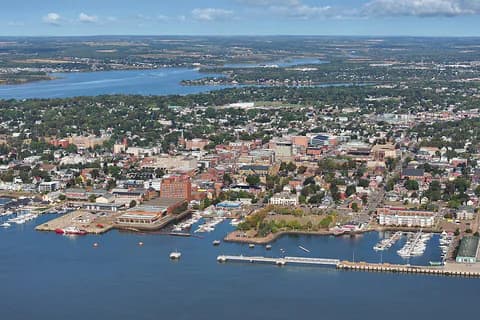
Photo: Quintin Soloviev(opens in a new tab), CC BY 4.0(opens in a new tab)
Population: 38,809 (Statistics Canada, 2021 Census)
Charlottetown is the capital of Prince Edward Island, and the City calls it Canada's Birthplace of Confederation, after the 1864 Charlottetown Conference that led to Confederation: the City says the first meetings on forming Canada took place there. It sits on the Island's south shore, and the City notes that many provincial and federal offices, as well as health and educational institutions, are located there.
The University of Prince Edward Island (UPEI) describes itself as a public institution. It was established in 1969, names Prince of Wales College and Saint Dunstan's University as its two founding institutions, and has campuses in Charlottetown and St. Peter's Bay. Holland College has its Prince of Wales Campus on Weymouth Street in Charlottetown, and its Belmont Centre in the city is the central location for its Language Instruction for Newcomers to Canada (LINC) program.
The City has held free newcomer orientation sessions, open to new residents who have moved to Charlottetown from another town, province or country. They have included presentations from departments at City Hall and a tour of the Charlottetown Fire Department's Station 1.
Answer our free questionnaire and get a free summary of your eligibility for every Canada pathway we assess, including those in Prince Edward Island. The full report is a later choice, never a condition.
Start the free questionnaire