

Loading
Just a moment while this page opens.
Just a moment while this page opens.
Just a moment while this page opens.
How Quebec chooses immigrants, the Quebec streams our report checks, what changes if you already live, study or work in Canada, and what life is like in its main cities.

Photo: Ryan Sharpe / Wikimedia Commons(opens in a new tab), CC BY-SA 4.0(opens in a new tab)
Quebec selects its own skilled workers. It has a special agreement on immigration with the Government of Canada, so you apply to Quebec first and only then for permanent residence (PR, the right to live in Canada permanently). Quebec's Programme de sélection des travailleurs qualifiés (PSTQ), the Skilled Worker Selection Program, is for people who want to immigrate to Quebec as skilled workers, whether they are in Quebec or abroad. If Quebec selects you, it gives you a Québec Selection Certificate (Certificat de sélection du Québec, or CSQ). You then apply for PR to Immigration, Refugees and Citizenship Canada (IRCC), the federal immigration department, which makes the decision.
Quebec may invite people whose profile matches its needs and who meet the level of French required for their occupation. French is central: Quebec's government says French is both the sole official language of Quebec and its common language.
Yes, through its own system. Quebec selects its own skilled immigrants with the Skilled Worker Selection Program (PSTQ) before the federal government decides on their permanent residence, the status that lets you live and work in Canada with no time limit.
Skilled Worker Selection Program (PSTQ)A stream is one route within a program, with its own rules. Our report checks 12 Quebec streams against your answers.
For international students accepted by a school in Quebec who can pay their costs, and who need the province's own study permission, called a Quebec Acceptance Certificate.
For foreign workers offered a job by a Quebec employer with government approval to hire them, who need the province's own temporary work permission, called a Quebec Acceptance Certificate.
Entrepreneur Program Stream 1: Innovative Business
For people with an innovative business project in Quebec, supported by a Quebec organization that helps such businesses start and grow, who can also prove their spoken French.
Entrepreneur Program Stream 2: Business Startup
For experienced business managers with substantial personal wealth who want to start and run their own business in Quebec, and can prove their spoken French.
Entrepreneur Program Stream 3: Business Takeover
For people who want to buy and run an established Quebec business, with help from a Quebec organization that supports business takeovers, and can prove their spoken French.
For wealthy, experienced managers who make a large, government-guaranteed investment in Quebec for a fixed term, plus a payment that is not returned, and can prove their spoken French.
PSTQ Stream 1: Highly Qualified and Specialized Skills
For people whose main occupation is highly skilled, such as management, professional or specialized technical work, with recent experience from Quebec or abroad, and proven spoken and written French.
PSTQ Stream 2: Intermediate and Manual Skills
For people in intermediate or manual jobs, usually learned through short training or on the job, with recent experience that includes working in Quebec, and proven spoken French.
PSTQ Stream 3: Regulated Professions
For people whose occupation, such as nursing, needs a licence in Quebec, and who obtain that licence or official recognition of their training from the Quebec body in charge.
PSTQ Stream 4: Exceptional Talent
For people with exceptional, proven achievements in their line of work, shown by an achievement on Quebec's official list or an opinion from a Quebec partner organization.
Quebec-Selected Skilled Workers
For skilled workers selected by the province of Quebec, which gives the people it chooses a Certificat de sélection du Québec (CSQ)
For people with recent experience working for themselves in their profession who want to do so in Quebec, have enough personal wealth and can make a start-up deposit.
It starts in Arrima, Quebec's online immigration services platform, where you file an expression of interest, also called a declaration of interest: a profile saying you want to immigrate to Quebec to work. Once you create it, you have 90 days to complete and submit it. It then stays valid for one full year (12 months) and cannot be extended or renewed, though you can create a new one. You do not need to pay anyone to fill it in.
Quebec's immigration department, the Ministère de l'Immigration, de la Francisation et de l'Intégration (MIFI), invites people stream by stream in three steps. First, it matches profiles to a stream using your main occupation and that stream's requirements for work experience, French and education. Second, it may target a specific profile, for example people with a diploma earned in Quebec. Third, it decides how many people to invite and invites the people with the highest scores until it reaches that number; nobody is chosen at random. Scores reflect criteria such as your French, age, work experience and education, a Quebec diploma, work experience in Quebec, a job offer validated by the MIFI and family in Quebec.
An invitation arrives in your Arrima message centre, and you have 30 days from its date to accept it; if you do not respond in that time, your expression of interest becomes null and void. After you accept, the application page says you then have 60 days to submit your application for permanent selection. Under Stream 3: Regulated professions, the limit is one year if you do not yet have proof that the regulatory body for your profession recognizes your qualifications.
A CSQ does not make you a permanent resident: Quebec says that once you have it, you must continue your immigration process with the Canadian government. Quebec also has no provincial nominee program, the route other provinces use to recommend immigrants: IRCC says Quebec and Nunavut don't have programs, and our guide to provincial nominee programs explains that route. For Express Entry, the federal online system that ranks skilled workers, IRCC's Federal Skilled Worker Program page says you must plan to live outside Quebec and that the province selects its own skilled workers; our Express Entry guide explains that system.
Quebec measures French on its own scale, the Échelle québécoise des niveaux de compétence en français (Quebec scale of French proficiency levels). The PSTQ's requirements page sets the level by stream. Stream 1 asks for oral French at level 7 or higher and written French at level 5 or higher. Stream 2 asks for spoken French at level 5 or higher. Under Stream 3, the level depends on your occupation's FEER category, which groups jobs by the training, education, experience and responsibilities they usually require; Quebec reads it from the second digit of the occupation's five-digit National Occupational Classification (NOC) code. The page lists no French level for Stream 4: Exceptional talent. Under Streams 1, 2 and 3, an accompanying spouse or partner also needs spoken French at level 4 or higher.
You must prove your French even if it is your mother tongue, with a test or diploma the MIFI accepts, such as the TCF or TEF tests or a DELF or DALF diploma, and test results must be two years old or less when you apply for permanent selection. There is no English language requirement in the PSTQ.
French shapes daily life too. Under the Charter of the French language, government bodies serve the public in French, but they may use another language to welcome immigrants during their first six months in Quebec. The same page names Francisation Québec as the government's single access point for learning French for adults who live in Quebec or plan to settle there.
Quebec's permanent programs for skilled workers and business people ask for the Attestation d'apprentissage des valeurs démocratiques et des valeurs québécoises: proof that you know the democratic values and Quebec values expressed in the Charter of Human Rights and Freedoms. Quebec's page lists the PSTQ and the Entrepreneur, Self-Employed Worker and Investor Programs among those that need it. Family members who come with you need one too, except children under 18 and people with a permanent physical or cognitive disability that prevents them from obtaining it.
You get it online or by attending an Objectif Intégration information session in Quebec. After you file your application you receive a request, and you then have a maximum of 60 days to obtain the attestation, or your application is rejected. If neither you nor your family members hold a valid Canadian study or work permit, you start with the online assessment; after two failed attempts you choose between a third online attempt and an Objectif Intégration session. The attestation stays valid for two years.
The Certificat d'acceptation du Québec (CAQ, Québec Acceptance Certificate) is a permission issued by Quebec for a temporary stay. To become a foreign student, Quebec says you need a CAQ and a study permit, and its conditions for studying include showing you can cover the costs, keeping health and hospital insurance for your whole stay and making your studies your main activity. Under the Temporary Foreign Worker Program, a worker needs a CAQ from Quebec and a work permit from the Government of Canada. From 17 December 2028, Quebec will check that people applying for a work CAQ under that program after three years of working in Quebec have spoken French at level 4; some workers, including agricultural workers, are exempt.
On 1 January 2026, Quebec's permanent immigration pilot programs for food processing workers, orderlies, and workers in artificial intelligence, information technologies and visual effects ended as planned. When it confirmed that end date in November 2025, Quebec said applications already submitted would continue to be examined, and that people in the occupations those pilots targeted could file an expression of interest in Arrima instead.
For 2026, Quebec's immigration plan aims to admit 45,000 permanent immigrants and, for the first time, also plans temporary admissions under the Temporary Foreign Worker Program and the International Student Program.
On 30 January 2026, the immigration minister presented the PSTQ invitation plan for 2026. Invitations in 2026 would give priority to Quebec graduates, to people working in strategic sectors such as health, education, construction, early childhood and engineering, and to diverse profiles with the strongest potential for economic and language integration.
On 13 May 2026, the MIFI began giving priority to processing PSTQ applications from temporary foreign workers whose work permits have expired or are about to expire.
On 10 June 2026, Quebec announced that the Programme de l'expérience québécoise (PEQ), the Québec Experience Program for temporary foreign workers and for international students who graduated in Quebec, would reopen for two years, from 2 July 2026 to 2 July 2028. It set 2 July to 31 October 2026 as the period for receiving applications, from people who on 19 November 2025 already held an eligible Quebec diploma or had at least two years of Quebec work experience in an occupation in FEER category 0, 1, 2 or 3.
If you qualify for coverage, register with the Régie de l'assurance maladie du Québec (RAMQ) for Quebec's health insurance plan; the province's Settle and integrate in Québec guide says each member of your family needs their own health insurance card. Quebec's driver's licence exchange agreements let newcomers from several countries exchange their licence for a Quebec one without an exam or driving lessons; its page for temporary workers says the exchange starts with an appointment at the Société de l'assurance automobile du Québec (SAAQ). Accompagnement Québec is Quebec's free, personalized integration service, with agents in all regions. IRCC's Find free newcomer services near you tool leaves out service providers in Quebec, which runs its own integration services.
Quebec's selection rewards time spent there, through the Quebec factors listed in the section on how the PSTQ picks people. Quebec's invitation criteria also score your spouse's or partner's Quebec work experience and Quebec diploma, and let the MIFI require a stay in Quebec, or Quebec work in your main occupation, for an invitation round. The Montreal and Quebec City sections explain how time outside the Montreal metropolitan community can count. Stream 2 asks for two years of full-time or equivalent paid work in your main occupation within the five years before you apply, at least one of them in Quebec.
If you work in Quebec on a permit, these sections also apply:
After your studies, IRCC's post-graduation work permit (PGWP) can let you gain Canadian work experience if you graduated from an eligible school, though graduating does not make you eligible on its own.
In Quebec's own selection, a Quebec diploma adds to your score and may be required for an invitation round, as the section on how the PSTQ picks people explains; the invitation criteria also score time spent studying in Quebec. The section on what changed in 2026 names Quebec graduates among the 2026 invitation plan's priorities.
The Programme de l'expérience québécoise (PEQ) is another Quebec route to a CSQ, for temporary foreign workers and international students who graduated in Quebec. Its graduate stream takes only diplomas obtained in Quebec, so a diploma from another province does not qualify; the section on what changed in 2026 gives its 2026 application period. Our report does not assess the PEQ, so your free summary will not show it even if you qualify.
For the PSTQ, work elsewhere in Canada is work outside Quebec: Stream 1 accepts it, while Stream 2 accepts at most a year of it. The Canadian Experience Class (CEC), the Express Entry program for skilled workers with Canadian work experience, requires a plan to live outside Quebec, so someone settling in Quebec goes through Quebec's own selection instead; IRCC still counts work done while living in Quebec for someone who settles in another province. To study in Quebec, see the CAQ section.
Quebec's settlement guide says all residents of Quebec are eligible for its health plan, which generally does not cover your first three months in Quebec; ask your current province's plan what it covers meanwhile. By status:
The first-steps section names the RAMQ and the SAAQ, which handles licence exchanges. If your driver's licence is from another province or territory, the SAAQ's page on licences from elsewhere says you can drive on it for your first six months after settling in Quebec, and after that you need a Quebec licence. You exchange it for the equivalent Quebec class, with no tests if it is valid or expired less than three years ago, and you can start as soon as you settle. To register for Accompagnement Québec, Quebec's free integration service, you need a CSQ, a CAQ or an IRCC client number (the one on your Canadian immigration documents).

Photo: Paulthelawyer(opens in a new tab), CC BY-SA 4.0(opens in a new tab), cropped
Population: 1,762,949 (Statistics Canada, 2021 Census)
Montreal belongs to the Communauté métropolitaine de Montréal (CMM), the metropolitan community that groups Montreal with Longueuil, Laval and neighbouring municipalities and whose council the mayor of Montréal chairs, according to Quebec's government. That line appears in Quebec's immigration rules. Quebec's Skilled Worker Selection Program (PSTQ), which invites skilled workers to apply for permanent selection, can use invitation criteria based on time spent in Quebec outside the CMM and on whether a job offer validated by Quebec is inside or outside it. The Self-Employed Worker Program asks for a larger start-up deposit on CMM territory than outside it.
Quebec's page for people who hold a CSQ, the Québec Selection Certificate, says that when they arrive through Montréal-Trudeau International Airport, a welcome team from Quebec's immigration department greets them and can sign them up for information sessions about Quebec.
McGill University teaches in English, though certain programs with a mandatory internship in a hospital, clinic, social service centre or school require proficient French. Concordia University, founded in 1974 by the merger of Loyola College and Sir George Williams University, took its name from Montreal's motto, Concordia salus. Université de Montréal has HEC Montréal and Polytechnique Montréal as affiliated schools, and UQAM, the Université du Québec à Montréal, is a French-language university whose École de langues also teaches French as a second language.
For daily life, the City's newcomer page says community organizations in Montreal's neighbourhoods offer free help with finding housing, looking for work, registering children for school or daycare and learning French. The City also issues an identity and proof of residence card, through a confidential process, to people who do not have or are awaiting immigration status.
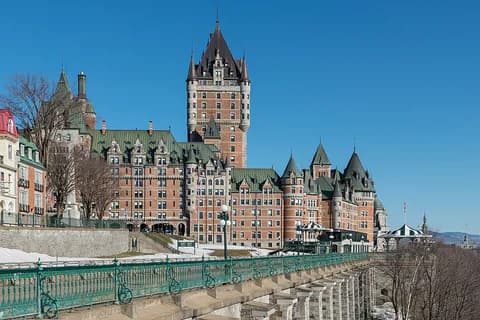
Photo: DXR(opens in a new tab), CC BY-SA 4.0(opens in a new tab), cropped
Population: 549,459 (Statistics Canada, 2021 Census)
Quebec City, the provincial capital, stands on the shores of the St. Lawrence River, as the City of Québec describes itself. It belongs to a different metropolitan community from Montreal's: the Communauté métropolitaine de Québec, which groups the Québec agglomeration with Lévis and nearby regional municipalities, and whose council the mayor of Québec chairs. Time spent here therefore counts as a stay in Quebec outside the Montreal metropolitan community (CMM) under the invitation criteria of Quebec's Skilled Worker Selection Program (PSTQ), which invites skilled workers to apply for permanent selection.
Each year, the City holds a welcome day of free activities to mark the arrival of new immigrants, including a chance to discover the city's services and organizations. Its page on getting around says the Réseau de transport de la Capitale (RTC) runs public transit throughout the city.
Université Laval, which describes itself as a French-language institution, is part of Quebec City's university community.

Photo: Harleyd613(opens in a new tab), CC BY-SA 4.0(opens in a new tab), cropped
Population: 291,041 (Statistics Canada, 2021 Census)
Gatineau is in Quebec, but the City of Gatineau says that together with Ottawa, Ontario, it is part of Canada's Capital Region, and the Société de transport de l'Outaouais, a City agency, runs buses across Gatineau and even to Ottawa. Living on the Quebec side matters for immigration: the federal program for workers Quebec selects is for skilled workers who want to become permanent residents and live in Quebec, and they apply to Quebec first.
The City's new residents page notes that health and education are the Quebec government's responsibility, and it points immigrants to the Quebec government's integration service, whose agents can help even before you arrive.
The Université du Québec en Outaouais (UQO) has its Alexandre-Taché and Lucien-Brault pavilions in Gatineau. UQO says that its location right beside Ottawa gives students multicultural and bilingual surroundings, and that it is part of the Université du Québec system.
Answer our free questionnaire and get a free summary of your eligibility for every Canada pathway we assess, including those in Quebec. The full report is a later choice, never a condition.
Start the free questionnaire