

Loading
Just a moment while this page opens.
Just a moment while this page opens.
Just a moment while this page opens.
How New Brunswick chooses immigrants, the New Brunswick streams our report checks, what changes if you already live, study or work in Canada, and what life is like in its main cities.

Photo: BJames (EdWH)(opens in a new tab), CC BY-SA 4.0(opens in a new tab), cropped
To move to New Brunswick for good, one route is the province's own immigration program, the New Brunswick Provincial Nominee Program (NBPNP). Immigration New Brunswick selects and nominates candidates based on their skills, education and work experience in relation to the province's economic needs. A nomination is a recommendation, not permanent residence (PR, the right to live in Canada for good). Immigration, Refugees and Citizenship Canada (IRCC), the federal immigration department, then makes its own decision, which rests partly on your medical exam and police certificate.
The province presents the NBPNP as offering pathways to PR for graduates, workers and entrepreneurs. New Brunswick also works in two languages by law: under Canada's Charter of Rights and Freedoms, English and French are its official languages.
Yes. New Brunswick runs the New Brunswick Provincial Nominee Program (NBPNP), a provincial nominee program: the province chooses (nominates) people it wants, and the federal government then decides on their permanent residence, the status that lets you live and work in Canada with no time limit.
New Brunswick Provincial Nominee Program (NBPNP)A stream is one route within a program, with its own rules. Our report checks 11 New Brunswick streams against your answers.
For experienced business owners or senior managers who have enough personal wealth, invest in and run a New Brunswick business, and create a full-time job for someone outside their family.
For workers with a full-time, year-round, permanent job offer from a named New Brunswick employer taking part in this pilot; only those employers can put candidates forward.
NBPNP Express Entry Employment in NB
For people who have a profile in Express Entry, Canada's online system for skilled workers, and have been living and working full time in New Brunswick in a skilled job.
NBPNP Express Entry NB Interests
For people who have a profile in Express Entry, Canada's online system for skilled workers, and whom New Brunswick invites because they match its priorities, such as close family there.
For people already working full time, year-round, for a New Brunswick employer who supports their application, and living in the province.
For graduates of a New Brunswick college or university with a full-time, year-round skilled job, or a job offer, from a New Brunswick employer who supports their application.
For workers who received a full-time job offer, in a job the province lists as a priority, through a recruitment event led by the New Brunswick government.
NBPNP Private Career College Graduate Pilot
For graduates of selected programs at New Brunswick private career colleges who, soon after graduating, find full-time, year-round work in the province in a priority occupation related to their studies.
NBPNP Strategic Initiative Francophone Priorities
For French speakers who studied in person at the Université de Moncton or the Collège communautaire du Nouveau-Brunswick, or who received a letter of interest from the province.
NBPNP Strategic Initiative Francophone Workers
For French speakers living in New Brunswick, or hired through a provincial recruitment event, who have a full-time, permanent job or job offer from a New Brunswick employer.
NBPNP Strategic Initiative Francophones Remote
For French speakers who live in New Brunswick and work remotely for a Canadian employer based outside Quebec.
Every NBPNP application begins with an expression of interest (EOI), an online questionnaire you submit through the INB portal, Immigration New Brunswick's online system. According to the program's page, your EOI then waits in a candidate pool for up to 365 days. Immigration New Brunswick invites only selected candidates to apply, based on the province's labour market needs, the nominations it has available and other priorities set by the provincial government, and some streams have scheduled invitation draws.
The program's page says that submitting an EOI does not mean you will be invited, even if you meet the criteria. If you are invited, you must send a complete application within the time your invitation letter sets, and it will be refused if you cannot show Immigration New Brunswick that you meet all requirements. You can have only one active application with Immigration New Brunswick at a time.
Under the province's immigration agreement with Canada, a nominee must apply to IRCC for PR within the time limit on their nomination, and the NBPNP page says a nominee may not withdraw a nomination certificate to reapply under another of the province's programs. Our guide to provincial nominee programs sets out what a nomination does and does not give you.
The New Brunswick Express Entry stream is for highly skilled people in Express Entry, IRCC's online pool that ranks candidates by points. Its New Brunswick Interest pathway requires a letter of interest received in your federal Express Entry profile. IRCC says a nomination made through Express Entry is worth 600 extra points, and our Express Entry guide covers the federal side.
The Atlantic Immigration Program (AIP) is a separate route to PR for skilled foreign workers and recent graduates of a college or university in Atlantic Canada. It starts with an employer, who must first be designated by the province. IRCC's step-by-step outline says the designated employer then applies for an endorsement, and the candidate sends the provincial endorsement certificate to IRCC with their PR application.
Immigration New Brunswick keeps two candidate pools, one for NBPNP EOIs and one for AIP endorsement applications. The NBPNP page says you may sit in both, with a separate INB profile for each, but can move forward with only one: if you receive an NBPNP invitation, or your AIP application is selected for processing, you must withdraw your other submissions.
When you deal with the provincial government or its courts, yes. The Charter gives New Brunswick's English and French linguistic communities equal status, including the right to their own educational and cultural institutions. It also lets anyone use English or French in the province's courts, and gives every member of the public the right to be served by provincial government offices in either language.
For immigration, the NBPNP includes the New Brunswick Strategic Initiative, which its page says is for French-speaking people who want to live and work in the province. Beyond the NBPNP, IRCC's Francophone Community Immigration Pilot offers PR to skilled workers who want to work and settle in rural, remote Francophone (French-speaking) minority communities, and its list of participating communities shows which ones take part.
Register for New Brunswick Medicare, the provincial health insurance plan; Health Canada's health card page links to the province's Medicare registration. If you drive, the province's page on licences for new residents says people from outside Canada and the United States who settle in New Brunswick must pass a vision test, a written exam and a road test, unless they are nationals of a country on its reciprocity list, who can exchange their licence for a Class 5 licence without testing. New Brunswick's immigration page points newcomers to information on housing, health care, education and legal services, and IRCC's Find free newcomer services near you tool lists funded settlement help for those who qualify.
Several of New Brunswick's pathways count time already spent living and working there:
Graduating does not by itself let you keep working in Canada: graduates of certain Canadian schools are eligible for IRCC's post-graduation work permit (PGWP). New Brunswick's pathways then look at where you studied:
A diploma from another province meets none of these conditions, though the Atlantic Immigration Program section above also covers recent graduates of colleges and universities across Atlantic Canada.
Months lived or worked in another province do not count toward the time in New Brunswick that the pathways in the first two rows ask for. A job with an employer elsewhere in Canada can count, though: for French speakers, the Francophones Working Remotely in New Brunswick pathway of the Strategic Initiative asks for 12 months living in New Brunswick while working remotely, throughout that time, for a Canadian employer located outside Quebec.
Whether and when Medicare covers you (registering is in the first-steps section above) depends on your situation. Moving from within Canada, new residents (citizens and permanent residents included) may be covered from the first day of the third month after the month they settle for good; contact your former province or territory to keep your cover until then. By status:
A driver from another province must get a New Brunswick licence on taking up residence; the licence page says it can be exchanged class for class without a driving test if it does not expire within six months, and students can wait until they settle permanently or start working.
These federal programs run only in some provinces or communities, and New Brunswick is one of them.
For skilled workers and graduates of Canadian colleges and universities with a job offer from a province-approved employer in New Brunswick, Nova Scotia, Prince Edward Island, or Newfoundland and Labrador.
Atlantic Immigration Program: official pageFor French speakers with a job offer from an employer approved by a participating French-speaking community outside Quebec, and a recommendation from that community, where they plan to settle.
Communities taking part in New Brunswick
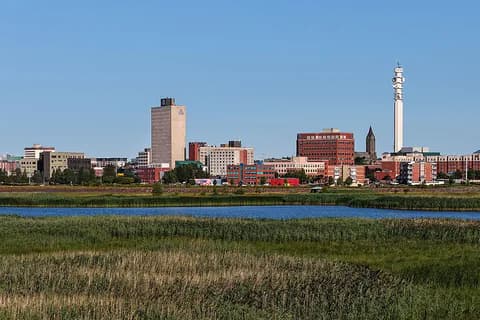
Photo: Quintin Soloviev(opens in a new tab), CC BY 4.0(opens in a new tab), cropped
Population: 79,470 (Statistics Canada, 2021 Census)
Moncton lies in the heart of Maritime Canada along the Petitcodiac River, known for its tidal bore, as the City of Moncton describes it. Under its official languages policy, the City provides its services in both English and French.
Schooling follows the same two-language pattern. The City's Move to Moncton page explains that the Anglophone East School District offers English and French immersion, that the Francophone Sud School District offers a French curriculum, and that students attend the schools tied to where they live. The same page calls Université de Moncton a French-language university, and lists a New Brunswick Community College campus in Moncton and a Collège communautaire du Nouveau-Brunswick campus in neighbouring Dieppe. Université de Moncton also has campuses in Edmundston and Shippagan.
For newcomers, the Move to Moncton page links to the Greater Moncton Immigration website and a Newcomer's Guide, and notes that Codiac Transpo provides bus service across the Greater Moncton region.
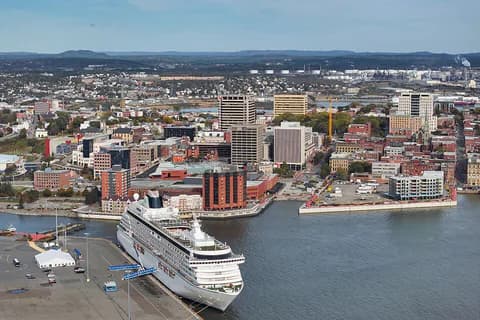
Photo: Quintin Soloviev(opens in a new tab), CC BY 4.0(opens in a new tab)
Population: 69,895 (Statistics Canada, 2021 Census)
Saint John, New Brunswick, is a different city from St. John's, Newfoundland and Labrador. It stands where the St. John River meets the Bay of Fundy, and the City's Moving to Saint John page describes its historic uptown neighbourhood, with a rare concentration of late nineteenth-century buildings.
According to the City's history page, the Mi'kmaq and Maliseet were the area's first inhabitants. Supporters of Britain arriving after the American Revolution settled at the mouth of the river in 1783, and the city was incorporated by Royal Charter in 1785. The same page says Saint John is also known as the Port City, and that it grew into an industrial centre in the nineteenth century, mostly through its shipbuilding trade.
The University of New Brunswick has a campus in Saint John as well as in Fredericton. Saint John Transit runs the city's buses, and its route finder uses Google Transit to suggest trips.
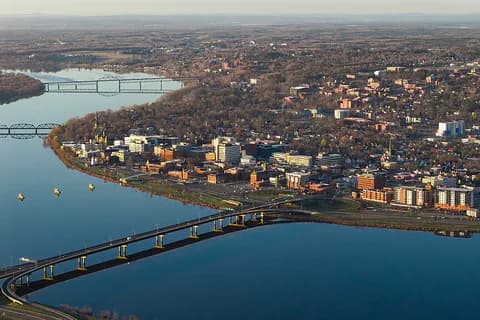
Photo: Quintin Soloviev(opens in a new tab), CC BY 4.0(opens in a new tab), cropped
Population: 63,116 (Statistics Canada, 2021 Census)
Fredericton is New Brunswick's capital, and the City's page for newcomers notes that the Legislature Building stands at 706 Queen Street and that many provincial departments are located in the city. The City's history page places it along a bend in the Wolastoq, the Saint John River, and says the name goes back to 1785, when Governor Thomas Carleton recommended that St. Anne's Point become the capital under the name Frederick's Town, in honour of Prince Frederick, Duke of York.
The University of New Brunswick has one of its campuses here, and its About page says it was founded in 1785. St. Thomas University, a primarily undergraduate university focused on the liberal arts, is also in Fredericton.
For English as a second language, the City's newcomer page suggests starting with UNB's College of Extended Learning, the New Brunswick Community College network and the Multicultural Association of Fredericton, which it calls an excellent resource for getting settled.
Answer our free questionnaire and get a free summary of your eligibility for every Canada pathway we assess, including those in New Brunswick. The full report is a later choice, never a condition.
Start the free questionnaire